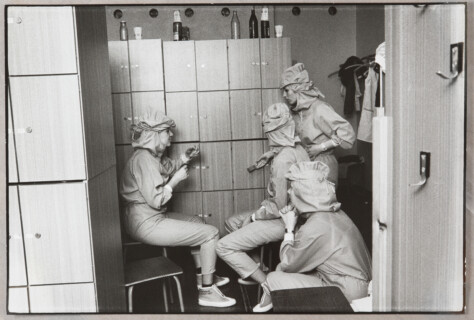
The exhibition Robotron. Code and Utopia features the work Pleinair Mikroelektronik Frankfurt (Oder) by photographer Marion Wenzel. In conversation with Franciska Zólyom, she presents her work.
In 1988, the Leipzig photographer Marion Wenzel visited the VEB Semiconductor Plant Frankfurt (Oder). Just a year later, the production of microchips and transistors was to be discontinued. At this moment, however, they were still being manufactured – for the GDR, the Soviet Union, and countries such as Poland, Romania and Czechoslovakia. Most of the factory workers were women. The sensitive semiconductor technology was manufactured in so-called ‘cleanrooms’, environments where not a single particle of dust could be allowed to enter. Workers could access them only by passing through an airlock. Before doing so, they put on special protective suits and head covering. Much of Wenzel’s artistic work focuses on photographing the changes in the landscape around Leipzig arising from lignite mining. She visited the factory as part of a plein air event together with other artists. She photographed a series of images in medium format and with direct flash to create proximity, capture details, and describe the working situation with highly sensitive technology. Before she could expand the series, the semiconductor plant was liquidated.
Marion Wenzel studied photography at the Academy of Fine Arts in Leipzig under Prof. Evelyn Richter. Inspired by her professor, she began photographing the open-cast mines in the south of Leipzig in the early 1980s. Over several decades, she created an archive that reveals the man-made changes to the landscape and the accompanying environmental destruction. From 2005 to 2025, Wenzel worked as a collection photographer for the University of Leipzig, documenting the university’s history in numerous photographs, including the removal of the Karl Marx relief, the demolition of the socialist campus buildings and the construction of the Paulinum.